
The Beechcraft Queen Air took the Model 50 Twin Bonanza wing, gear and systems and wrapped a cabin-class fuselage around them, giving Beech a nine-seat piston twin that sold to corporate flight departments, air taxi operators and the US Army.
Just over a thousand were built across seven production variants between 1960 and 1978, and the same airframe went on to become the Model 90 King Air and the Model 99 commuter.
Several hundred remain on civil registers, most of them B80s, flying charter, freight and parachute operations. Tires, brakes and consumables are shared with other Beech and Aero Commander twins, which keeps routine maintenance ordinary rather than specialist.
Beechcraft Queen Air Specifications
| Manufacturer | Beech Aircraft Corporation, Wichita, Kansas |
| Type | Cabin-class twin piston utility and executive transport |
| First flight | 28 August 1958 (Model 65 prototype) |
| Certification | FAA type certificate 4 February 1959 (Model 65); Model 80 certificated 20 February 1962 |
| Production status | Out of production, series ended 1978 |
| Units built | Approximately 1,005: 412 Model 65 and A65, 35 Model 70, 511 Model 80, A80 and B80, 47 Model 88 |
| Engines | 2 x Lycoming IGSO-540-A1A or A1D flat-six, 380 hp each (B80); 2 x Lycoming IGSO-480-A1A6, 340 hp each (Model 65) |
| Max range | Approximately 650nm with standard fuel at economy cruise (B80) |
| Cruise speed | Approximately 195 kt (224 mph) maximum cruise |
| Max operating altitude | 26,800ft |
| Takeoff distance | Approximately 2,556ft over a 50ft obstacle |
| Landing distance | Approximately 2,572ft over a 50ft obstacle |
| Max takeoff weight (MTOW) | 8,800 lb (3,992 kg) for A80, B80 and 88; 8,000 lb for the short-wing 65, A65 and 80 |
| Passenger capacity | 6 to 7 in executive layout, up to 11 in Queen Airliner configuration |
| Crew | 1 to 2 pilots |
| Price (new) | Approximately $120,000 bare and $170,000 equipped at launch (1960 reference) |
| Price (used) | Approximately $180,000 to $850,000 depending on variant, engine time and avionics (2026 listings) |
| Operating cost | Approximately $700 to $900 per hour variable, driven by 40 gph fuel burn and geared engine reserves |
Beechcraft Queen Air – History and Overview
Development and Background
Twin Bonanza owners told Beech what they wanted next, and most of it came down to cabin volume. Beech answered with the Model 65: the Twin Bonanza wing, landing gear, flaps and fuel system carried over, matched to a deeper fuselage with a separate flight deck and an airstair door. The prototype flew on 28 August 1958 and the FAA issued the type certificate on 4 February 1959.
The US Army had already bought the Twin Bonanza as the L-23 Seminole and ordered 68 of the new aircraft as the L-23F, later redesignated U-8F. Civil deliveries followed quickly, and in February 1960 a Queen Air set a class altitude record of 34,862 feet. Beech then spent two decades adding power, span and gross weight, and in one case pressurization.
The airframe doubled as Beech test bed for what came next. A Queen Air fitted with Pratt & Whitney Canada PT6A-6 turboprops, designated Model 87, flew on 15 May 1963 and led directly to the Model 65-90 King Air. The Model 99 commuter that followed used Queen Air wings with King Air engines and nacelles.
Design and Performance
Commonality is the Queen Air defining engineering trait. The wing, gear, flaps, fuel cells and much of the systems architecture are shared with the Twin Bonanza below it and the King Air above it. For owners, that lineage means a parts picture wider than the production numbers suggest.
Cabin comfort was the selling point a Twin Bonanza could not match: a separate pilot compartment, individual reclining chairs, a baggage area reachable in flight and, on later aircraft, a refreshment cabinet and toilet. Loading is easy, because the airstair door sits low and nobody climbs over a wing to board. That cabin is also why the type found a second career hauling freight and parachutists once the executive market moved to turbines.
The engines are what operators actually talk about. Geared and supercharged, the Lycoming IGSO-480 and IGSO-540 flat-sixes give strong climb and useful altitude performance, but they want disciplined power handling, attentive cooling and close watch on manifold pressure. Flown gently they reach TBO; flown carelessly they are expensive.
Short-wing and long-wing variants differ enough to matter when buying. The 65, A65 and 80 keep the original span at 8,000 pounds gross, while the A80, B80 and 88 add span and another 800 pounds.
Variants
- Model 65 – initial version, 340 hp Lycoming IGSO-480 engines, straight tail, short wing, 7,700 lb then 8,000 lb gross weight
- A65 – from 1967, swept vertical tail and greater fuel capacity, otherwise close to the straight 65
- Model 80 – introduced 1961 and certificated 20 February 1962, first Queen Air with the swept tail, 380 hp IGSO-540 engines, 8,000 lb gross weight
- A80 – 1964, longer span wing and gross weight raised to 8,800 lb
- B80 – 1966 to 1978, the final and most numerous version, long wing, 380 hp or 360 hp IGSO-540 engines, 8,800 lb gross weight
- Model 70 – 1968, an A65 fuselage and engines on the B80 wing, 35 built
- Model 88 – 1965, the only pressurized Queen Air, round cabin windows, B80 wing and engines, 47 built before production ended in 1969
- L-23F and U-8F – US Army liaison and light transport version of the Model 65, 68 ordered
Operators
The US Army was the launch customer in all but name, flying the L-23F and U-8F in liaison and light transport roles into the 1970s. The Japan Air Self-Defense Force operated the A65 for liaison work, with examples still active into the mid 1990s. Civil use centered on air taxi and commuter work, including Air Chathams in New Zealand, Bemidji Airlines in the United States, Airfast Indonesia and Euralair in France.
Queen Airliner conversions seating up to 11 passengers carried much of the scheduled traffic for small operators in the Caribbean and South America. Freight, survey and parachute operations account for most of the remaining fleet activity today.
Current Status
Production ended in 1978 and the type is supported through Textron Aviation alongside a small group of specialist shops that know the geared Lycomings. Several hundred airframes remain registered worldwide, with the B80 by far the most common. The used market is thin rather than dead, with asking prices from roughly $180,000 for a tired airframe to $850,000 for a low-time example with current engines.
Engine availability shapes values more than airframe hours do. Overhauls on the IGSO series are expensive and the shops that do them well are few, which is why Excalibur conversions fitting Lycoming IO-720 engines in place of the originals command a premium. Tires and brakes stay straightforward, because both sizes are common across several Beech and Aero Commander twins.
Beechcraft Queen Air Landing Gear and Tires
Landing Gear Configuration
The Queen Air uses a retractable tricycle undercarriage with a single wheel on each leg, the main units folding into the engine nacelles. Nose wheel steering works through the rudder pedals and the main wheels carry hydraulic brakes. Tyre fitment is consistent across the Model 65, 70, 80 and 88, so a straight 65 and a B80 take the same sizes despite the 800 pound difference in gross weight.
Gear rigging and brake wear are the routine inspection items, and the tire sizes themselves did not change across the production run. Operators working from unpaved strips, which is common with this airframe, should expect shorter tire life than paved-runway figures suggest.
Beechcraft Queen Air Tire Specifications
| Main gear tire size | 8.50-10, 8 ply rating, tubeless |
| Nose wheel tire size | 6.50-10, 6 ply rating, tubeless |
| Ply rating | 8PR main gear, 6PR nose wheel |
| Tire pressure (typical) | Published in the aircraft maintenance manual; verify against the AMM for the serial number and configuration |
| Compatible brands | Michelin, Goodyear, Dunlop, Condor |
| Part numbers | Listed in the Approved and Compatible Brands section below |
Always verify specifications against the aircraft maintenance manual and applicable airworthiness directives before ordering. Serial number and configuration can affect tire requirements.
Main Gear Tires
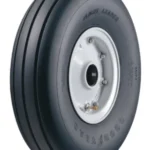
Both main wheels take an 8.50-10 tire at an 8 ply rating, tubeless, the fitment Goodyear and Michelin both list for the Model 65, 70, 80 and 88. The rating covers the 8,800 pound gross weight of the long-wing variants with margin, and the size is widely stocked because it also serves the King Air 90, the Aero Commander piston twins and several agricultural types. Replacement is on condition: tread wear and sidewall cracking usually decide the interval before landing count does.
Nose Wheel Tire
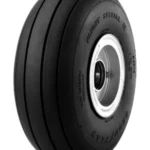
The nose wheel takes a 6.50-10 tire at a 6 ply rating, tubeless, running at lower pressure than the mains. Wear comes mostly from taxi scuffing and shimmy, so inspect the shimmy damper whenever nose tire wear looks uneven.
Approved and Compatible Brands
DMI Aviation stocks tires for the Beechcraft Queen Air from the following approved manufacturers:
- Michelin – 025-349-0 – 8.50-10, 8 ply rating, main gear
- Michelin – 076-367-0 – 6.50-10, 6 ply rating, nose wheel
- Goodyear – 850C86-2 – 8.50-10, 8 ply rating, main gear
- Goodyear – 650T66-3 – 6.50-10, 6 ply rating, nose wheel
- Dunlop – DR8628 – 8.50-10, 8 ply rating, main gear
- Condor – 072-376-0 – 8.50-10, 8 ply rating, main gear
- Condor – 078-345-0 – 6.50-10, 8 ply rating, nose wheel alternative, confirm rating against the AMM
Frequently Asked Questions
Is the Beechcraft Queen Air still in production?
No. Beech ended Queen Air production in 1978 after approximately 1,005 airframes, having already moved the market to the King Air and the Model 99. Several hundred remain registered worldwide, and parts, engine overhauls and tires are still available through normal supply channels.
What are the Beechcraft Queen Air specifications?
The B80, the definitive production variant, carries two 380 hp Lycoming IGSO-540 engines, an 8,800 pound maximum takeoff weight, a 26,800 foot service ceiling and up to 11 seats in Queen Airliner configuration. Full figures are in the specifications table above.
What is the range of the Beechcraft Queen Air?
Roughly 650 nautical miles with standard fuel at economy cruise in the B80. Published figures across the family run from about 630 to 755 nautical miles depending on variant, fuel fit and power setting.
What is the Beechcraft Queen Air price?
A new Model 65 sold for about $120,000 bare and roughly $170,000 equipped with radios, radar and accessories. Used examples in 2026 ask from approximately $180,000 for a high-time airframe to $850,000 for a low-time B80 with current engines and upgraded avionics.
What does the Beechcraft Queen Air cost to operate per hour?
Budget approximately $700 to $900 per hour in variable costs. Fuel burn around 40 gallons per hour and overhaul reserves for the geared Lycomings dominate that figure, and actual costs vary with utilization, region and engine condition.
Where can I find a Beechcraft Queen Air for sale?
Listings appear on Controller, Trade-A-Plane and Aircraft.com, and through brokers who handle vintage Beech twins. Inventory is thin, often fewer than ten aircraft worldwide at any one time, so the right airframe and engine combination is worth waiting for.
What is the Beechcraft Queen Air landing distance?
Approximately 2,572 feet over a 50 foot obstacle for the B80 at typical landing weight, sea level and ISA conditions. Takeoff over the same obstacle needs about 2,556 feet.
What tire size does the Beechcraft Queen Air use?
Main gear tires are 8.50-10 at an 8 ply rating, tubeless, and the nose wheel takes a 6.50-10 at a 6 ply rating, tubeless. The fitment is the same across the Model 65, 70, 80 and 88. Verify against the AMM for your serial number and configuration before ordering.
Which tire brands are approved for the Beechcraft Queen Air?
Michelin, Goodyear, Dunlop and Condor all produce both sizes in the required ply ratings. The part numbers listed above are the current stocked options at DMI Aviation.
How much do Beechcraft Queen Air tires cost?
Pricing varies by brand, ply rating and speed rating. Current pricing sits on the individual product listings linked above.
What is the tire pressure for the Beechcraft Queen Air?
Inflation pressures are maintenance manual data and change with aircraft weight and configuration, so use the AMM figures rather than a general published value. Under-inflation is the most common cause of premature sidewall failure on types of this vintage.
How long do Beechcraft Queen Air tires last?
Expect replacement on condition rather than a fixed cycle count. Aircraft worked from paved runways commonly get several hundred landings from a set of mains, while unpaved operations can halve that. Tread depth, sidewall cracking and cut damage decide the interval.
How often should Beechcraft Queen Air tires be changed?
Change when tread reaches the wear limit in the AMM, when cord shows, or when cuts, bulges or sidewall cracking appear. Nose tire wear and shimmy damper condition should be assessed together, and a licensed engineer should make the final call against the aircraft maintenance program.