
Picture Daniel, a maintenance planner for a charter fleet, standing beside a Praetor 600 that has just come in from a long overwater leg. The crew loves the airplane: it has the longest range in its class, on a design that started life as a midsize. Daniel’s question is smaller and more urgent: the left outboard main tire is close to its wear limit, and he needs the right part number before the next trip.
To understand that tire, it helps to know where the airplane came from.
A clean sheet in São José dos Campos
Embraer launched the Legacy 450 and 500 program in April 2008. The idea was bold for the midsize class: full fly-by-wire flight controls, sidesticks and a flat-floor, stand-up cabin. Software work on the flight control system took longer than planned, and the first Legacy 500 did not fly until November 2012. Embraer test pilots Mozart Louzada and Eduardo Camelier were at the controls for that first flight from the company’s home at São José dos Campos, Brazil.
Brazil’s ANAC certified the Legacy 500 in August 2014, and the FAA followed that October. It was the first jet in its class with full fly-by-wire.
From Legacy 500 to Praetor 600
Embraer did not stop there. Flight testing of an upgraded version began on 31 March 2018, quietly. By the time the company unveiled the Praetor 600 at the NBAA convention in October 2018, three aircraft had already logged about 300 hours.
The changes were real ones. Extra fuel tanks raised capacity to roughly 16,100 lb. Honeywell HTF7500E engines delivered 7,528 lb of thrust each. Taller, wider winglets stretched the span. The result was a super-midsize jet with 4,018 nm of range with four passengers and NBAA IFR reserves, the longest in its category.
ANAC certified the Praetor 600 in April 2019, with FAA and EASA approval in May. Deliveries began in mid-2019, and Flexjet took its first aircraft that December under an order for 64 Embraer jets.
The family ties matter for parts. The Legacy 500 shares its type certificate with the Praetor 600, but because of systems changes a Legacy 500 cannot be converted to Praetor 600 standard. The shorter Legacy 450 and Praetor 500 are a separate model, the EMB-545, on the same certificate.
The numbers Daniel works with
| Figure | Praetor 600 |
|---|---|
| Engines | 2x Honeywell HTF7500E, 7,528 lb thrust each |
| Max range | 4,018 nm, four passengers, NBAA IFR reserves |
| Max operating speed | Mach 0.83 |
| Ceiling | 45,000 ft |
| Max takeoff weight | 42,858 lb (19,440 kg) |
| Main gear tire | H26.5×8.0R14, 14 ply, radial |
| Nose gear tire | 17.5×5.75-8, 10 ply, chined |
On the flight deck, the Collins Pro Line Fusion avionics and a 2,165 ft unfactored landing distance at typical landing weight let the Praetor 600 use airports that force some rivals to offload fuel or passengers. Short runways and high weights are exactly what the tires feel.
Four radials and a chined pair up front
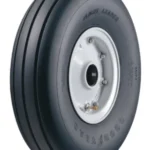
The main gear carries two wheels per side, four H26.5×8.0R14 radial tires in total. In our catalog the Praetor 600 main gear fitment is the Goodyear Flight Radial 269Q43-2: H26.5×8.0R14, 14 ply, 210 mph, NEW. Radial construction runs cooler and lighter than a bias tire of the same size, which matters on a jet of more than 42,000 lb.
The same footprint also comes in bias construction. The Goodyear Flight Leader 269K43-2 is an H26.5×8.0-14 at 18 ply and 210 mph, listed for the Legacy 450/500 and the Challenger 300/350. It is a different tire from the Praetor 600 radial, so confirm against your documents before treating one as the other.
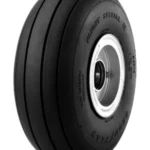
The twin nose wheels take a 17.5×5.75-8 chined tire. The chine throws runway water and slush outboard, away from the rear-mounted engines. The Goodyear Flight Eagle 178K03-1, 10 ply and 210 mph, is listed for the Legacy 450/500 and Praetor 500/600.
Embraer publishes inflation pressures in the Praetor 600 maintenance manual, not in public documents. Take them from there for your serial number.
Back on the ramp
Daniel does not need the history to change a tire, but it explains what he sees: a midsize-born airframe asked to carry super-midsize fuel, sitting on radials sized for the job. His next step is plain. He checks the tag on the worn tire, matches it to the maintenance manual and the parts catalog for that serial number, and orders.
Always confirm the part number against your aircraft’s approved documentation. A different ply rating or speed rating is a different tire.
Know your part number? Type it in the search bar at the top of this page, or request a quote.