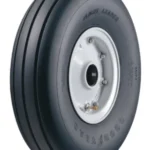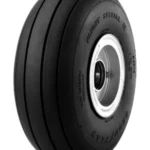

Picture Ben, who runs the stores for an operator still flying Fokker 100s on long charter days. A nose tire request lands on his desk. He finds a 24×7.7 on the rack, the right size, and almost signs it out. Then he reads the ply rating on the tag: 14. The Fokker 100 wants 10, at a higher speed rating.
That small difference is the end of a long story about a Dutch company that bet on stretching an airplane it already had.
Stretching the Fellowship
In 1983 Fokker announced two new aircraft, the Fokker 50 turboprop and the F28 Mark 0100, the replacement for its own F28 Fellowship jet. The plan leaned on what Fokker already knew. It kept the F28 fuselage cross-section, stretched the body by about 5.7 meters, fitted a new wing, a glass flight deck and two Rolls-Royce Tay turbofans on the rear fuselage. To this day the aircraft is certificated as a Mark of the F28 rather than as a type of its own.
The prototype, PH-MKH, flew on 30 November 1986. The Dutch authorities approved the type on 20 November 1987, and Swissair took the first aircraft on 29 February 1988, putting it into service that April.
Big orders, then a hard landing
The sales came fast. In March 1989 American Airlines ordered 75, the largest customer the type would ever have. TAM in Brazil ordered 50 and USAir 40. KLM, Austrian and Portugalia built out the European fleets.
The airplane seated around 107 passengers five abreast, up to 122 at maximum, and cruised at Mach 0.77. Early aircraft carried the Tay Mk 620-15 of 13,850 lb thrust, and later and high gross weight aircraft took the Tay Mk 650-15 of 15,100 lb.
The early 1990s turned against Fokker as new Airbus, Boeing and regional jet designs arrived. The company was declared bankrupt in March 1996, and production ended in early 1997 after 283 aircraft plus two prototypes. American retired its fleet by 2004. The Fokker 100 has now outlived its maker by three decades, and today the biggest fleets work in Australia and Papua New Guinea.
| Spec | Fokker 100 |
|---|---|
| First flight | 30 November 1986 |
| Engines | 2 x Rolls-Royce Tay Mk 620-15 (13,850 lb) or Mk 650-15 (15,100 lb) |
| Max takeoff weight | 95,000 lb standard; 101,000 lb high gross weight |
| Passengers | 107 typical, 122 maximum |
| Built | 283 plus two prototypes |
Six tires and a chine
The Fokker 100 sits on a hydraulically retracting tricycle gear with twin wheels on all three legs, six tires per aircraft. The mains retract inboard and the nose retracts forward. Carbon brakes with anti-skid do the stopping, and on short sectors flown many times a day the tires wear by cycles, not hours.
Each main leg carries two H40x14.0-19 tires at 20 ply, rated to 225 mph. In NEW tires we list the Goodyear Flight Leader 409K02-2, the Dunlop DR26521T and the Bridgestone APS01456, all at the same 20 ply and 225 mph. A retreaded 409K02-2 is also in our catalog. The COMAC ARJ21 uses the same main size, which helps keep it in production.
The nose takes two 24×7.7 tires at 10 ply, rated to 225 mph, in the chined deflector type, with the chines fitted outboard. With both engines on the rear fuselage, the chines throw standing water sideways instead of up into the intakes. A plain nose tire is the wrong part on this aircraft. The options are Goodyear 247F02G1, which Goodyear lists for the Fokker 100 by name, Dunlop DR15852T and Bridgestone APS01142.
The same tires fit the shorter Fokker 70, which kept the Fokker 100 landing gear. Inflation pressures come from the aircraft maintenance manual and vary with weight variant.
The tag that mattered
Ben puts the 14 ply tire back. It belongs to a BAe 146 or a Saab 340, not to his airplane. He pulls a 10 ply 247F02G1 instead, and the Fokker flies its first sector on time. Always confirm the part number against your aircraft’s approved documentation. A different ply rating or speed rating is a different tire.
Know your part number? Type it in the search bar at the top of this page, or request a quote.