
Picture Dana, a maintenance controller for a small flight department. Her G280 is due for a main tire change, and the logbook in front of her says the airplane first flew as something called a G250. She has two part numbers on a sticky note and one question she cannot shake: how does a jet end up with a different name than the one it flew under?
The answer is a short story about two companies, one wing and a number that did not travel well.
A follow-on to the G200
In 2005, Gulfstream Aerospace and Israel Aerospace Industries began designing a successor to the Gulfstream G200, the midsize jet the two companies already built together. The new model was launched in 2008 as the G250. It kept the G200’s fuselage cross-section, but almost everything that mattered was reworked.
The rear fuselage fuel tank came out, which added 17 inches of usable cabin. Four more windows went in, along with access to the baggage compartment. The wing was new and larger, 495 square feet against the G200’s 369, and it used the airfoil from the Gulfstream G550. Spirit AeroSystems built that wing. IAI built the fuselage, the tail and the landing gear in Israel.
Power came from two Honeywell HTF7250G turbofans of 7,624 pounds of thrust each.
First flight in Tel Aviv, and a new name
The G250 made its first flight on December 11, 2009, in Tel Aviv. Testing went on through 2010 and into 2011. Then, in July 2011, Gulfstream changed the name. The company said G280 was “a more amenable number sequence” in certain cultures, and the jet has been the G280 ever since.
Israel issued a provisional certificate in December 2011. Full certification from Israel and the United States followed on September 4, 2012, and deliveries began that year. By June 2025, 300 had been delivered.
So the sticky note on Dana’s desk belongs to an airplane with two birth certificates in a sense: the G250 that flew, and the G280 that was certified and sold.
The numbers that define it
| Spec | G280 |
|---|---|
| Builders | Gulfstream Aerospace and Israel Aerospace Industries |
| First flight | December 11, 2009 (as G250) |
| Certification | Israel and United States, September 4, 2012 |
| Engines | 2 x Honeywell HTF7250G, 7,624 lb thrust each |
| Max takeoff weight | 39,600 lb (17,960 kg) |
| Range | 3,600 nm at Mach 0.80 with four passengers |
| Maximum speed | Mach 0.84 |
| Main tires | 26×6.6R14, 14 ply, tubeless radial |
| Nose tire | 18×4.4, 12 ply, tubeless |
Where the tires come in
When the jet entered service in 2012, Michelin announced its Air X radial as original equipment.
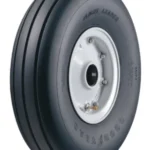
The main gear runs a 26×6.6R14 radial, 14 ply, and Michelin Air X is original equipment. We list Michelin M08401 in that size, at 225 mph. Confirm it against your IPC for your serial number. Our catalog also cross-references the Goodyear radial in the same size and ply, 266Q42-1, which it lists for the Falcon 20, 50 and 200; treat it the same way and check it against your approved documentation before you order.
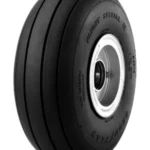
The nose wheel takes an 18×4.4, 12 ply tubeless tire rated to 210 mph. Our catalog lists 027-614-0, the Michelin tire whose application list names the Gulfstream G280. The nose tire carries far less load than the mains, but it does the steering work on every taxi, so it earns its own inspection at each tire change.
DMI is an authorized distributor for Michelin and Goodyear, and you can see more business jet fitments on our business jet tires page.
Back to the sticky note
Dana’s two part numbers turn out to be the main tire and the nose tire, not two versions of the same thing. The name on the logbook was never the problem. The size, ply and speed rating on the tire are what count.
Always confirm the part number against your aircraft’s approved documentation. A different ply rating or speed rating is a different tire.
Know your part number? Type it in the search bar at the top of this page, or request a quote.