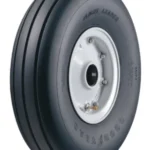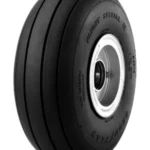

Picture Marta, who buys tires for a regional operator. She has a quote in front of her for the tire her aircraft uses, and a second offer for a tire in the very same size that costs less and could ship sooner. The only difference on paper is a number in the description: a different ply rating. It looks like an easy saving. She calls to ask whether it is an approved alternate.
Sometimes there is an approved alternate. Often there is not. Size alone does not identify an aircraft tire. Ply rating and speed rating are part of what the aircraft is approved to use, and they explain why Marta’s easy saving may not be one.
A number that used to count layers
Ply rating began as a literal count. Early tires were built from layers of cotton fabric, and the ply number told you how many there were. Then stronger fibers such as nylon arrived, and fewer layers could carry the same load. The number stayed, but its meaning changed. Goodyear’s tire care manual now defines ply rating as an index of carcass strength, or load carrying capacity. It does not count the layers in the tire.
A higher ply rating means the tire is built for a higher load at a higher inflation pressure. One size can be made in a wide spread of ratings for aircraft of different weights. In our catalog, the 24×7.7 tire appears in 8, 10, 12 and 16 ply versions, among others. Each is a different part number.
How fast the tire is proven to go
The speed rating is the maximum ground speed the tire is tested and qualified for, usually given in miles per hour. Common ratings are 120, 160, 190, 210, 225 and 235 mph. The tire has to cover your aircraft’s takeoff and landing speeds, with nothing left to chance.
Where substitution goes wrong
A tire with a different ply rating or speed rating is a different tire, even in the same size. Fitting a lower rating than the aircraft requires is unsafe. A higher rating is not automatically acceptable either, because the aircraft’s approved documentation lists specific part numbers. A higher rated tire is built for a different load and inflation pressure, and the documentation is written for the tire that was approved.
So the answer to Marta’s question does not come from the price. It comes from the manual, or from the tire she is replacing. Check one of them and order by part number.
The other marks on the sidewall
While Marta is reading the tire, a few more markings are worth knowing:
- Bias or radial: a dash in the size (27×7.75-15) is bias, an R (27×7.75R15) is radial. Do not mix them unless your documentation allows it.
- TL or TT: tubeless or tube-type.
- Tread: most aircraft tires have a ribbed tread. Some nose tires have a chine, a ridge molded into the sidewall that throws water sideways, away from the engines.
Marta’s decision
Marta checks the documentation. The cheaper tire is not on it, so she stays with the part number her aircraft is approved for and moves on to the next order. That is the whole lesson of ply and speed ratings in one decision: the number on the tire has to match the number in the book.
Always confirm the part number against your aircraft’s approved documentation. A different ply rating or speed rating is a different tire.
Know your part number? Type it in the search bar at the top of this page, or request a quote. DMI Aviation Sales is an authorized Michelin, Goodyear and Dunlop distributor in Medley, Florida.